Direct sales agents filled applications on a phone at a borrower's home or shop, often with poor connectivity, and 34% of files were rejected at processing for document quality or missing fields.
STUDY 21 / 30 · ANONYMISED · NDA · NBFC & LENDING · INDIA · 8,400 DSAS
NBFC & LENDING · INDIA A loan application built for the agent, on the borrower's doorstep.
RoleLead designer + researcher
Timeline11 weeks
Team2 designers, 1 researcher, 1 PM, 2 mobile engineers
VerticalOrigination app · DSA field network
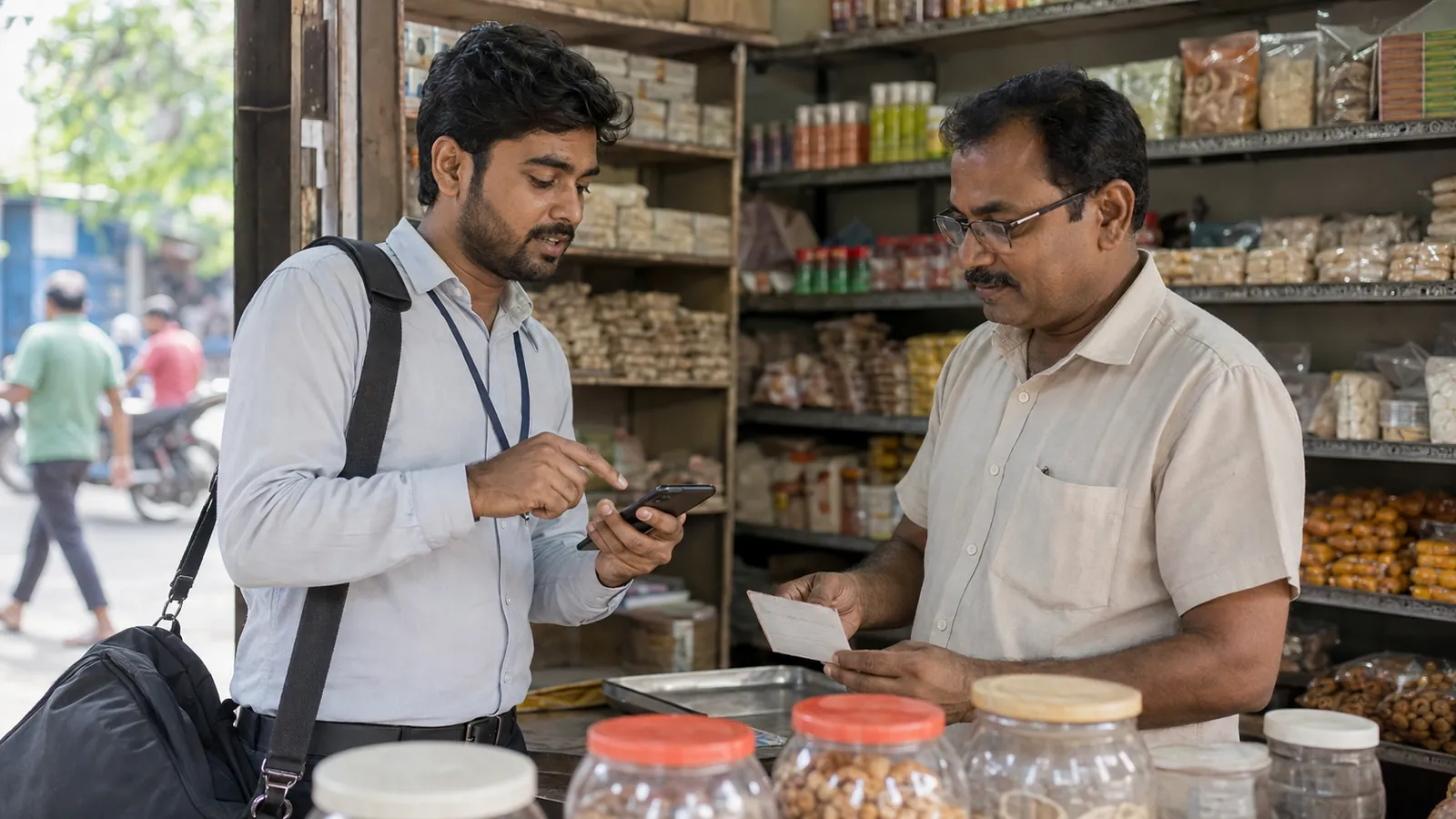
Designed for the actual condition - one-handed, outdoors, low light, patchy signal - with document quality validated at capture rather than at processing three days later.
File rejection at processing fell by more than half, which compressed disbursal time and removed the most common cause of borrower drop-off.
14%FILES REJECTED AT PROCESSINGfrom 34%
3.1 daysTIME TO DISBURSALfrom 8.4
96%FIELDS COMPLETED ON FIRST VISITfrom 61%
THE ARGUMENT
Why the obvious solution was wrong.
The study matters because the product problem was reframed before the interface was polished.
The application had been designed on a desktop and deployed to a phone held in one hand at a shop counter with a borrower watching. Every failure traced to that gap. Document photographs were rejected days later for glare or crop, by which time the agent was in another district. Required fields that depended on a document the borrower did not have to hand stalled the visit and lost the applicant.
Document capture now validates at the moment of capture: glare, crop, blur and readability are checked on-device in under two seconds, and the agent is told to retake before leaving. The flow reorders around what the borrower is likely to have with them, deferring the rest to a resumable second pass. Everything works fully offline with an explicit sync queue. Rejection at processing fell from 34% to 14%, and the disbursal compression came almost entirely from not having to send an agent back.
THE INTERFACE CRAFT
The interaction, rendered as a working product surface.
The specimen below is code-native and uses the study's own design logic. The client interface remains protected.
NBFC & LENDING
DECISION TRACEAPPROVE
5 factors · 2 overrides
DESIGN DECISIONS
Positions we would defend.
Each decision names the principle and the product consequence, not a stylistic preference.
Design for the doorstep
A form designed at a desk and used at a shop counter will fail at the counter. We built and tested in the field condition.
Move validation to the moment
A rejection three days later costs a return visit. A rejection two seconds later costs a retake.
Never stall the visit
A missing document should defer, not block. A blocked visit is usually a lost application.
PRODUCT LEADER READOUT
What transfers, and what should remain specific to this product.
A case study is useful when its operating principle travels without turning the original interface into a template.
Read the operating condition
For Origination app · DSA field network, the transferable lesson is not a copied screen. It is the condition the interface had to make legible: Glare, crop, blur and readability checked on-device in under two seconds. The retake happens while the agent is still there. Rebuild that visibility for your own roles, risk, terminology, and operating cadence.
Protect the design rule
A form designed at a desk and used at a shop counter will fail at the counter. We built and tested in the field condition. Keep that rule in the acceptance criteria, component states, and production QA record so later visual cleanup cannot erase why the interaction exists.
Measure behaviour after ship
The evidence record is 14% for files rejected at processing, from 34%. Recreate the baseline and outcome window before rollout, segment the result by role and context, and state clearly what the measure cannot prove.
RESEARCH RECORD
The work behind the interface.
These artefacts connect the final interaction back to the evidence and product model that produced it.
Field ride-alongs
Accompanied 14 DSAs across three states through 40 full applications, recording every stall, retake and abandonment.
Rejection cause analysis
Coded 1,200 processing rejections; 62% were document quality and 71% of those were glare or crop.
On-device validation spec
Defined the quality thresholds with the processing team so field validation matched processing acceptance exactly.
Low-light capture test
Tested capture guidance across shop interiors, doorways and outdoor midday glare, the three real conditions.
“The agent finds out about a bad photo while he is still standing there. That is the whole difference.”
Head of Distribution, NBFC · under NDA
NEXT STUDY · 22 / 30 · NBFC & LENDING